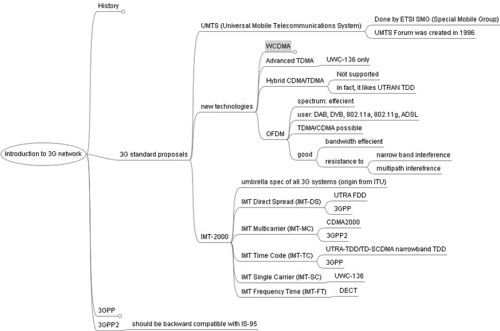
It’s a shame not knowing common knowledge of 3G networks while working in a mobile phone manufacturer. Well, Obviously, some people do not think so. Here’s the brief outline of radio network change: from first generation to 2G, 2.5G, and 3G. Although 4G is coming on its way, knowing current technologies will help catching up the new ones.
- Introduction to 3G network
- History
- 1G
- NMT (Nordic Mobile Telephone)
- NMT-450
- NMT-900
- International Roaming is possible
- Scandinavia, Ecntral and Southern Europe
- TACS (Total Access Communications System)
- UK standard, based on AMPS
- 900 MHz
- AMPS (Advanced Mobile Phone Service)
- US standard
- 800 MHz
- MCS
- NTT: first cellular network in Japan
- NMT (Nordic Mobile Telephone)
- 2G
- Feature
- use digital radio transmission for traffic
- basic GSM uses 900 MHz
- 1800 MHz
- GSM (Global System for Mobile communications)
- Most successful and widely used 2G system
- TDMA
- D-AMPS (digital AMPS)
- US-TDMA, IS-136, or just TDMA
- CDMA IS-95 (Code-division Multiple Access)
- Developed by Qualcomm
- the only 2G CDMA standard so far
- IS-95 also called cdmaOne (brand name)
- PDC (Personal Digital Cellular)
- Frequency bands
- 800 MHz
- 1500 MHz
- Feature
- physical layer: similar to D-AMPS
- protocal stack: resembles GSM
- Only operated in Japan
- Frequency bands
- Digital Cordless systems
- CT2
- DECT (Digital Enhanced Cordless Telecommunications)
- PHS (Personal Handyphone System)
- Feature
- 2.5G
- new technologies
- HSCSD High-speed Circuit-switched Data)
- allocate 4 time slots for transmisstion (9.6 Kbps or 14.4 x 4)
- summary
- Good: software updates to network, and phone; good for real time apps
- Bad: usage of scarce radio resources
- GPRS (General Packet Radio Services)
- up to 115 Kbps
- packet switched
- suitable for non real-time apps
- bursty data is well handled
- do not guarantee an absolute maximum delay
- EDGE (Enhanced Data Rates for Global Evolution)
- 3 folds of original GSM speed
- 8PSK (eight-phase shift keying)
- GPRS –> EGPRS
- 384 Kbps maximum
- HSCSD High-speed Circuit-switched Data)
- IS-136 + (GPRS || EDGE) –> 2.5G
- Qualcomm
- CDMA2000 1xRTT
- IS-95: 14.4 Kbps, 1xRTT: 64 Kbps
- IS-95 + IS-95B or upgrade CDMA2000 1xRTT –>2.5G
- HDR (High Data Rate)
- 2.4 Mbps
- standardized in IS-856
- 1xEV-DO (1x Evolved Data Optimized)
- Add a TDMA component beneath code component
- CDMA2000 1xRTT
- PDC-P (NTT DoCoMo)
- i-mode
- new technologies
- 1G
- 3G standard proposals
- UMTS (Universal Mobile Telecommunications System)
- Done by ETSI SMG (Special Mobile Group)
- UMTS Forum was created in 1996
- new technologies
- WCDMA
- the bandwidth is 5 MHz or more (144kbps, 384kbps or even 2Mbps
- network
- Synchronous
- CDMA2000
- compatible with IS-95
- manufacturer: Qualcomm, Lucent, Motorola
- use ANSI-41 core network
- 3GPP2 (less support than 3GPP)
- good/not good
- good: effecient radio interface
- bad: expensive H/W
- CDMA2000
- Asynchronous
- ETSI/ARIB WCDMA
- most popular 3G system
- manufacturer: Ericsson, Nokia, NTT DocoMo
- rename to UTRAN (FDD)
- based on GSM MAP network
- 3GPP
- ETSI/ARIB WCDMA
- Synchronous
- feature
- fast power control
- vary bit rate, service params on frame by frame basis
- Advanced TDMA
- UWC-136 only
- Hybrid CDMA/TDMA
- Not supported
- in fact, it likes UTRAN TDD
- OFDM
- spectrum: effecient
- user: DAB, DVB, 802.11a, 802.11g, ADSL
- TDMA/CDMA possible
- good
- bandwidth effecient
- resistance to
- narrow band interference
- multipath interefrence
- WCDMA
- IMT-2000
- umbrella spec of all 3G systems (origin from ITU)
- IMT Direct Spread (IMT-DS)
- UTRA FDD
- 3GPP
- IMT Multicarrier (IMT-MC)
- CDMA2000
- 3GPP2
- IMT Time Code (IMT-TC)
- UTRA-TDD/TD-SCDMA narrowband TDD
- 3GPP
- IMT Single Carrier (IMT-SC)
- UWC-136
- IMT Frequency Time (IMT-FT)
- DECT
- UMTS (Universal Mobile Telecommunications System)
- 3GPP
- an org that develops spec for 3g system based on UTRA radio interface
- partners
- ETSI
- ARIB
- TTA
- TTC
- CWTS(china wireless telecommunications Standard
- ULTRA
- FDD
- vocabs
- chip: a bit in a code word
- spreading factor: chip rate / data bit rate
- spreading code: a sequence of chips used to modulate the data bits
- up/down use separate freq bands
- chip rate: 3.84 Mcps
- vocabs
- TDD
- NOrmal: 3.84 Mcps
- TD-SCDMA: 1.28 Mcps
- channels
- physical (air interface)
- transport
- between layer 1 and 2
- define how data is sent over the air
- logical
- within layer 2
- define the type of data to be sent
- FDD
- 3GPP2
- should be backward compatible with IS-95
- History
and here’s the Introduction to 3G network in tree view for better reading.