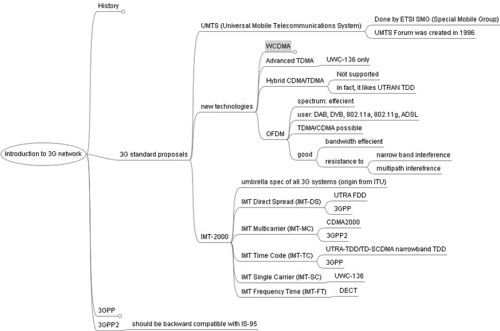
It’s a shame not knowing common knowledge of 3G networks while working in a mobile phone manufacturer. Well, Obviously, some people do not think so. Here’s the brief outline of radio network change: from first generation to 2G, 2.5G, and 3G. Although 4G is coming on its way, knowing current technologies will help catching up the new ones.
Introduction to 3G network History 1G NMT (Nordic Mobile Telephone) NMT-450 NMT-900 International Roaming is possible Scandinavia, Ecntral and Southern Europe TACS (Total Access Communications System) UK standard, based on AMPS 900 MHz AMPS (Advanced Mobile Phone Service) US standard 800 MHz MCS NTT: first cellular network in Japan 2G Feature use digital radio transmission for traffic basic GSM uses 900 MHz 1800 MHz GSM (Global System for Mobile communications) Most successful and widely used 2G system TDMA D-AMPS (digital AMPS) US-TDMA, IS-136, or just TDMA CDMA IS-95 (Code-division Multiple Access) Developed by Qualcomm the only 2G CDMA standard so far IS-95 also called cdmaOne (brand name) PDC (Personal Digital Cellular) Frequency bands 800 MHz 1500 MHz Feature physical layer: similar to D-AMPS protocal stack: resembles GSM Only operated in Japan Digital Cordless systems CT2 DECT (Digital Enhanced Cordless Telecommunications) PHS (Personal Handyphone System) 2.5G new technologies HSCSD High-speed Circuit-switched Data) allocate 4 time slots for transmisstion (9.6 Kbps or 14.4 x 4) summary Good: software updates to network, and phone; good for real time apps Bad: usage of scarce radio resources GPRS (General Packet Radio Services) up to 115 Kbps packet switched suitable for non real-time apps bursty data is well handled do not guarantee an absolute maximum delay EDGE (Enhanced Data Rates for Global Evolution) 3 folds of original GSM speed 8PSK (eight-phase shift keying) GPRS –> EGPRS 384 Kbps maximum IS-136 + (GPRS || EDGE) –> 2.5G Qualcomm CDMA2000 1xRTT IS-95: 14.4 Kbps, 1xRTT: 64 Kbps IS-95 + IS-95B or upgrade CDMA2000 1xRTT –>2.5G HDR (High Data Rate) 2.4 Mbps standardized in IS-856 1xEV-DO (1x Evolved Data Optimized) Add a TDMA component beneath code component PDC-P (NTT DoCoMo) i-mode 3G standard proposals UMTS (Universal Mobile Telecommunications System) Done by ETSI SMG (Special Mobile Group) UMTS Forum was created in 1996 new technologies WCDMA the bandwidth is 5 MHz or more (144kbps, 384kbps or even 2Mbps network Synchronous CDMA2000 compatible with IS-95 manufacturer: Qualcomm, Lucent, Motorola use ANSI-41 core network 3GPP2 (less support than 3GPP) good/not good good: effecient radio interface bad: expensive H/W Asynchronous ETSI/ARIB WCDMA most popular 3G system manufacturer: Ericsson, Nokia, NTT DocoMo rename to UTRAN (FDD) based on GSM MAP network 3GPP feature fast power control vary bit rate, service params on frame by frame basis Advanced TDMA UWC-136 only Hybrid CDMA/TDMA Not supported in fact, it likes UTRAN TDD OFDM spectrum: effecient user: DAB, DVB, 802.11a, 802.11g, ADSL TDMA/CDMA possible good bandwidth effecient resistance to narrow band interference multipath interefrence IMT-2000 umbrella spec of all 3G systems (origin from ITU) IMT Direct Spread (IMT-DS) UTRA FDD 3GPP IMT Multicarrier (IMT-MC) CDMA2000 3GPP2 IMT Time Code (IMT-TC) UTRA-TDD/TD-SCDMA narrowband TDD 3GPP IMT Single Carrier (IMT-SC) UWC-136 IMT Frequency Time (IMT-FT) DECT 3GPP an org that develops spec for 3g system based on UTRA radio interface partners ETSI ARIB TTA TTC CWTS(china wireless telecommunications Standard ULTRA FDD vocabs chip: a bit in a code word spreading factor: chip rate / data bit rate spreading code: a sequence of chips used to modulate the data bits up/down use separate freq bands chip rate: 3.84 Mcps TDD NOrmal: 3.84 Mcps TD-SCDMA: 1.28 Mcps channels physical (air interface) transport between layer 1 and 2 define how data is sent over the air logical within layer 2 define the type of data to be sent 3GPP2 should be backward compatible with IS-95 and here’s the Introduction to 3G network in tree view for better reading.